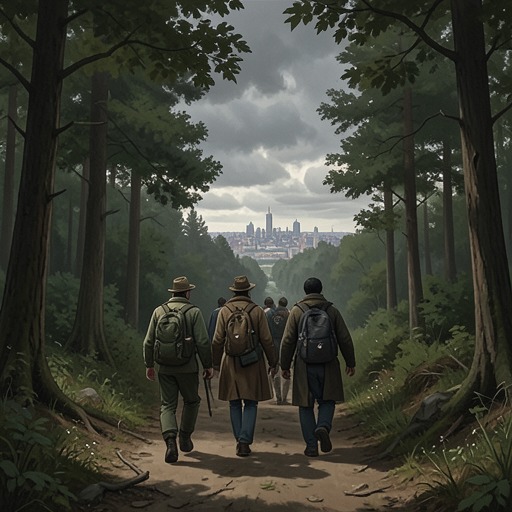
Georgia Flu quarantine warning
Station ElevenThe Georgia Flu quarantine warning marks a boundary between people fleeing the pandemic and places they can no longer safely reach. Seen at a roadblock near Severn City Airport, it warns that the flu is present and sick passengers are being kept apart; for travelers arriving too late, the sign makes clear that escape may already be impossible. Its recurrence links an airport’s uncertain isolation to the wider collapse of travel and public infrastructure.
The warning at the airport
At Severn City Airport, the first indication that the terminal had entered quarantine came through an Air Gradia agent’s radio: Clark Thompson heard the word as the airport display continued to announce the arrival of Flight 452. Roughly a hundred passengers remained at the terminal. Some had covered their mouths and noses, while others had left in response to the intercom announcement, only for some to return after finding no ground transport. The warning did not resolve whether those still inside were infected; it made uncertainty part of their confinement.
The scouting party later found the corresponding roadside barrier. A sign warned of quarantine, and the roadblock kept people from approaching the airport because it identified the flu as present among sick passengers. Beyond it lay abandoned cars, some containing bodies, and a nearby hotel the scouts chose not to enter. The sign thus served as practical information for anyone considering the airport, but also as a deterrent that helped leave its stranded population cut off from the surrounding area.
A boundary encountered too late
Years later, Kirsten Raymonde and her companions reached the airport roadblock in midafternoon. The old plywood sign still warned of the Georgia Flu; fallen traffic cones and orange fencing had collapsed around it. The warning survived as a fragment of the emergency response, but the scene no longer depended on an active authority to enforce it. Its message was legible in the remains of the barrier and in the abandoned traffic around it.
For Kirsten, the sign calls up the predicament of people who had fled through snow, perhaps carrying a sick child, only to discover at the end of their journey that there was nowhere beyond the barrier to go. Some might have turned back; others, exhausted or ill, might have stopped nearby. Her reflection makes the warning more than a notice about one quarantined site: it stands for the discovery that the disease has become inescapable. The roadblock cannot offer a route to safety; it announces the failure of that hope.
Quarantine amid collapsing mobility
The warning belongs to a world in which movement has changed from ordinary travel into risk, obstruction, or foot travel. During the first outbreak, Clark passed through an airport terminal already containing infected people and boarded one of the last planes to leave New York City. He was on the twenty-seventh-to-last departure from John F. Kennedy International Airport. The flight’s diversion to Severn City Airport brought him into the very setting where quarantine would soon shape the choices of passengers and staff.
Elsewhere, roads and transport failed in different ways. When Peter Raymonde and Kirsten tried to leave Toronto, their car became trapped among abandoned vehicles on the expressway ramps and side roads, and they continued on foot. The open border offered no equivalent guarantee of safety: it meant the guards had left, not that travel remained secure. In the post-collapse landscape, aircraft stood dormant rather than carrying travelers, while the Travelling Symphony’s former pickup trucks had been converted into horse-drawn caravans. Against these changes, a quarantine sign is both a warning about infection and a marker of how little dependable infrastructure remains.
Function and significance
The warning’s power comes from the gap between its simple instruction and the circumstances surrounding it. At the airport, it helps explain why people outside do not approach; at the roadblock, it confronts later travelers with the limits of flight from the disease. It does not itself provide treatment, transport, or a safe destination. Instead, it identifies danger while leaving those who encounter it to decide whether they can stop, turn back, or continue.
Its recurrence gives a public emergency measure a second life as landscape. First it is part of an immediate attempt to isolate an infected site; later it remains among the cones and fencing as a relic of the moment when people still hoped a boundary might separate safety from contagion. The novel’s changing forms of travel sharpen that contrast: the old promise of distance by air gives way to blocked roads, walking, and horse-drawn wagons, while the warning records a crisis in which movement alone cannot ensure escape.